


TINY BRANDS. BIG REALITY CHECKS. HOW SMALL BRANDS ACTUALLY GROW
Our real-world take on new research on small brands and growth
Since founding Pull in 2008, I’ve had one consistent obsession: understanding what genuinely makes small brands grow.
I started my career at Procter & Gamble, where brand management is a consistent, disciplined operating system. Many P&G alumni go on to do brilliant things in big businesses, largely because they apply that same discipline elsewhere.
But here’s what always intrigued me: those same people were often less successful when they became entrepreneurs or joined very small, fast-moving businesses.
There was something missing. You can’t simply apply big brand methodology straight to small brands and start-ups. The question was - what could you apply? What wasn’t applicable, and what other sources of advice could you rely on? Answering that was why I started Brand Marketing for Smaller Brands.
In creating the articles in it, I’ve drawn on three very different worlds:
- Proven brand marketing principles used by large, successful brands
- Instinctive marketing I’ve observed practised by natural entrepreneurs
- Marketing science, particularly the work coming out of the Ehrenberg-Bass Institute
The challenge is that these three worlds rarely come together, so I see my job as trying to bring the wisdom of the three to form practical help for small brand owners.
This is my attempt to translate the useful bits of an academic research publication into something practical for real-world brand owners.
(A word here on ‘small’ brands. Pull recently did a research and positioning project for a UK skincare brand. They had 2% unprompted awareness and c. 2% market share. They are a £100m business, yet by the definition of this research and this Substack they are very much a ‘small’ brand.)
Every now and then, the Ehrenberg-Bass Institute releases an interesting bit of research which they kindly make free to download.
When they used the rather un-academic term “tiny brands”, it immediately caught my eye.
Released in late 2025, the research focused specifically on brands with very small market share. It attempts to answer two questions:
- Do the rules from How Brands Grow still apply when your brand is genuinely small?
- If they do — what does that mean for how you should actually spend your money?
Before we get into answers, a few sobering facts it also revealed:
- Over 50% of brands in a typical consumer category have less than 1% market share
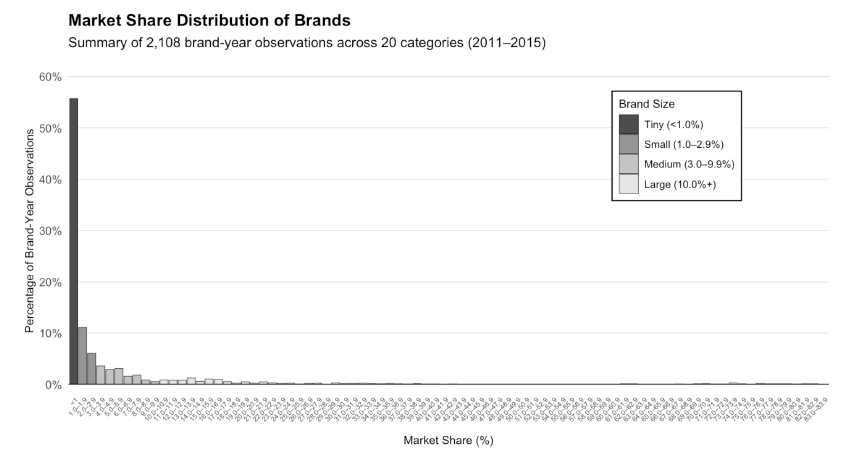
57% of category brands are tiny - have less than 1% share
- 1 in 3 new brands fails within two years
- Only 6% of tiny brands manage to hold a stable market share over five years
So yes — building a small consumer brand is brutally hard. You already know that.
The real question is whether marketing science can help you avoid the wrong bets.
The loyalty myth that trips small brands up
Much of this research was sparked by something called the Double Jeopardy Law, first explained in How Brands Grow.
OK, so what is the law of Double Jeopardy? In simple terms, it says this:
Small brands don’t just have fewer buyers — those buyers also buy them less often.
This is because:
- Bigger brands are more familiar
- Bigger brands are easier to find
- Buyers of small brands also buy big brands (and less the other way round).
Which leads to a very uncomfortable truth for founders:
We massively overestimate brand loyalty — especially to our own brand.
Consumers rarely truly ‘love’ a brand. They’re ‘cognitive misers’ according to Byron Sharp, author of How Brands Grow and Professor at the Ehrenburg-Bass Institute. They switch. They forget. They buy what’s visible and available. And they lean towards what they know – as we do with everything.
This matters because many small brands fall into two traps:
- Over-focusing on a “perfect niche” audience they believe will be really loyal to their brand.
- Under-investing in awareness and distribution, because they assume deep loyalty will do the work.
The research shows this is backwards.
What this means for small consumer brands (in plain English)
Based on this research — and our own work, especially in health & beauty — here’s what actually helps.
1. Be brutally honest about how people see your brand
(This is why we talk about Pull as having an ‘outside the jar’ perspective – where we can see the label – it’s hard to do that from inside the jar.)
You may have even developed the brand specifically for someone like you. You love it more than anyone else ever will. That’s normal — but dangerous. (Rule #1 of Marketing according to marketing guru Mark Ritson: You are not your buyer.
What to do:
Talk to customers. Do the research. Look at what else they buy. Assume you’re one option, not the obvious choice.
2. Stop assuming your audience is narrow but deep
Founders consistently believe their brand appeals to a very specific type of person.
In our experience, most buyers are from a far broader group in age, life stage and mindset than brand owners expect. (research we do shows this over and over).
What to do:
Avoid over-segmentation. Market to a wide group of buyers, not niche personas or even worse as we have seen - personas you’ve invented.
3. Distribution matters more than clever targeting
If people can’t find your brand, they won’t buy it — no matter how good it is. A useful rule of thumb:
Every extra 1% of penetration ≈ 1% more sales
What to do:
Prioritise distribution beyond your own D2C site. Protect it. Fight for it. If you are a premium or luxury brand – get some premium distribution.
4. Don’t rely solely on DTC
Your website will likely feel almost as dear to you as your brand itself. After all, it’s your chance to present and merchandise your brand how it should be. But to consumers, it’s invisible unless you constantly push traffic to it.
What to do:
Yes, sell DTC for margin. But wider retail distribution gives you reach, credibility and discoverability — especially if you’re a premium brand.
5. Treat loyalty schemes with scepticism
There’s very little evidence that loyalty programmes deliver strong ROI. They mostly reward people who were going to buy you anyway.
What to do:
Redirect that loyalty budget into brand awareness instead.
6. Make space for brand-building — even if it’s small
Many startups allocate nothing to long-term brand building. That’s a mistake.
You don’t need to start at 60% of budget. But you do need to start.
What to do:
Ring-fence at least 10% for brand-building in year 1. Increase that percentage gradually as the business grows.
Final thought
A lot of entrepreneurs think marketing is art. It is. Creativity matters — hugely — because it multiplies effectiveness. But marketing is also a science: observing behaviour, testing hypotheses, conducting experiments and discovery apply.
If you’re building a small brand, don’t ignore what marketing science can offer —
fortunately, I’m here to translate the relevant academic research for you. And give you what they never will - puppy photos.
That’s my job.
Posted 8 January 2026 by Chris Bullick