

HOW BRANDS BECOME ICONS: WHAT STILL MATTERS TWENTY YEARS LATER
We wanted to love this book and share useful insights from it with our readers, but we struggled to do so.
I like reading seminal books on marketing and doing my best to pull out core truths from them for my subscribers. I am perhaps trying to be true to Pull London’s mantra: “Behind every brand there’s a better story waiting to be told”. In doing this, perhaps a shorter story would be more accurate.
There was so much good stuff in ‘The Luxury Strategy’ that it made the basis for three articles on Luxury Brand Marketing:
2. What’s different in luxury brand marketing?
3. What can managers of non-luxury products learn from the rules of luxury branding?
In the third I strayed into ’Iconic Brands’ territory, by illustrating how 2 brands – Apple & Mini – had adopted selected brand strategies.
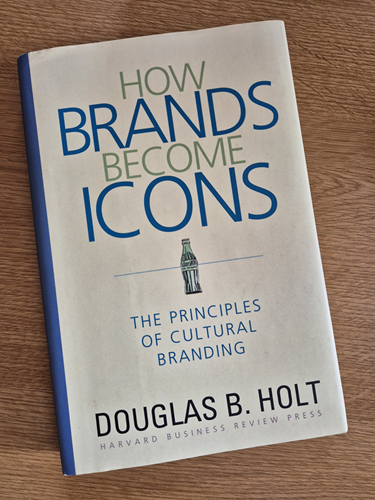
As a result, a reader pointed me at the 2004 book ‘How Brand Become Icons’ by American academic Douglas B. Holt.
Unfortunately, this book takes nearly 300 pages, several invented branding models, and repeated tours through fifty years of American social history to uncover them.
Having wrestled with it however, I can at least extract the insights that are there. Indeed, I can probably save you the trouble of reading the book itself, because I would struggle to recommend it. In summary:
- The book reflects its historical moment, arriving at the end of advertising’s golden age. A lot of the conclusions look less certain 20 years later.
- But it is frequently cited in branding circles – should it be?
- It does however contain one genuinely important idea that is probably worth further examination.
- It is a longer book than its’ insights require, wrapped in some jargon: – some self-created, which makes it harder to follow than it should be.
1. The Big Idea Holt gets right
There is one big insight for me. But it is rather elusive. I wish that Holt had expanded it into a theory of brands that could be used by marketers to ‘make my brand iconic’ (a big ask admittedly) and perhaps one reason he didn’t is something also somewhat hidden in the book – that some brands appear to become iconic through a combination of circumstance, timing and serendipity. This would obviously make it difficult to create a recipe from. He does make that point more explicitly in the case of one brand he studies, and one that I have a lot of anecdotal experience of – Harley Davidson. And I tend to agree with his conclusion.
Holt’s central proposition is that:
Iconic brand perform identity myths that address people’s desires and anxieties.
Or in plainer English:
People are drawn to brands that appear to address what they perceive to be missing, threatened or unresolved in the culture around them.
Examples:
- The Volkswagen Beetle making a counter-cultural stand vs. the excess of Detroit in the fifties and sixties.
- Harley Davidson speaking to an outlaw/cowboy counter-culture subdued by more sophisticated urban America.
- Corona beer reviving it’s ‘Spring Break Beach Party’ positioning in a sanitised form of simple holiday beach escape and hedonism.
- Mountain Dew morphing through the decades to reflect a positive view of masculinity while cultural values change.
While his evidence is never really overwhelming, Holt does seem to have identified a genuine phenomenon here. The idea seems to be that people are always hankering for resolution of the cultural anxieties of the day. Iconic brands appear to acknowledge these anxieties and offer a symbolic refuge from them.
Coca Cola did well out of WWII. Shipped out to GIs during the war, it was seen post-war as exemplifying the US myth of a war-winning machine and people - as American as apple pie. Later, the brand shifted to a ‘united nations’ stance (‘I’d like to buy the world a Coke’) in the aftermath of national psychosis and doubt over Vietnam. Both stances reflected the mood of the nation at the time, and the stories the brand told resonated with consumers.
2. The Harley Davidson Factor
It is no coincidence, in my view that one of Holt’s (almost infallible in his 2004 narration) brand icons from 2004 has largely fallen from grace. HD is commonly cited today as in crisis. I regularly refer to the brand to clients in the context of the brand’s aging user base.
In another life, some friends and I opened what was then the largest Triumph motorcycle showroom in the world in downtown Ft. Lauderdale, Florida.
We did this largely because we could see a British icon – Triumph – re-building its brand and reducing the average age of its owners, while watching the home grown Harley Davidson going the other way – the average age of its riders increasing by one year every year for nearly 20 years.
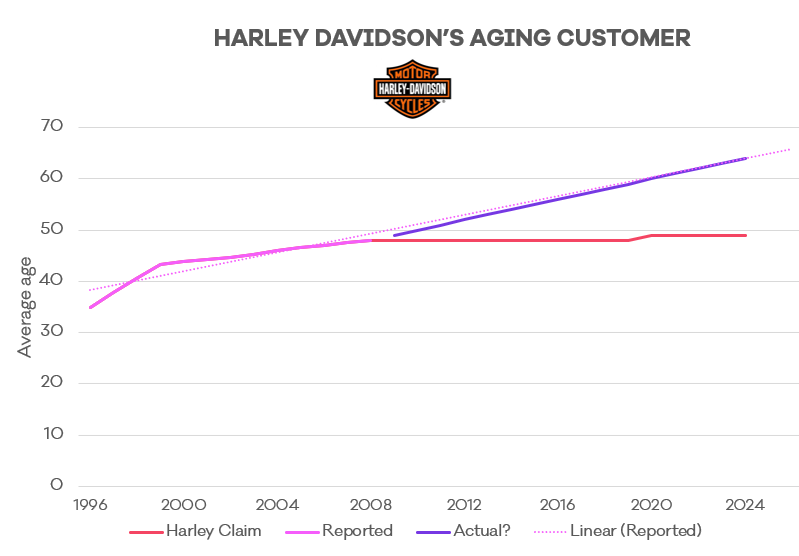
Holt’s argument is that many of the retrospective narratives celebrating Harley Davidson’s brand strategy are largely mistaken. That a bit like Coca Cola – the brand was in the right place at the right time. Again tied in with GIs who re-purposed war-time machines they had developed affection for, and later, first society’s relative rebels and outlaws (personified in the 1969 film Easy Rider) adopting the brand as a counter-cultural statement, then being adopted by more recent corporate and real-estate types seeking some of the same outlaw status for the weekend.
Holt’s take on this (which I strongly concur with based on personal experience) is that none of that was engineered by the brand – and I have seen no evidence that it was. But that the brand (wisely) simply recognised the direction of travel and embraced it, accepting and helping the brand’s adherents to “perform identity myths that address [their] desires and anxieties” with the brand.
But this is what leads me to also believe that – in contrast to luxury brand strategies – iconic brands typically stumble on something (Corona and spring break is a good example) that works – persist with it, and when necessary simply move it with the zeitgeist – to something more sanitised if need be.
3. What about those iconic brands today?
I often wonder how long Byron Sharp’s now-iconic How Brands Grow (now an incredible 16 years old) will continue to feel current. I believe although some of his examples will inevitably date (and they are all large FMCG brands), requiring revisions; but that the principals – laws as Sharp will have it – won’t date. Why? Because they are scientific and evidenced. In methodological terms, that book belongs in a different category.
By contrast the observations in How Brands Become Icons seem to belong much more obviously to another age. An age where:
- Most iconic brands were American – as he rightly points out, born out of and steeped in American cultural history.
- American culture and cultural myths were more strongly shared across the US, and more widely revered elsewhere.
- Local-origin US brands could be grown to suit a US national market through huge TV audiences consuming striking and creative campaigns. These campaigns have largely been replaced by digital communications that are often lower in emotional resonance and disproportionately focused on signalling corporate virtue.
I was left with a feeling that there are strong reasons why we might not see iconic brands like Holt’s examples arise again. As we have seen, at least one is likely to be perceived as ‘once iconic’; most of the others have done a better job of doing the thing I always say all brands need to do or die – progress.
The other thing that strikes me about Holt’s examples is that they are dominated by brands that have very little differentiation: Soft drinks and American beers. These are brands created almost completely through brand marketing. I used to spend a lot of time in the US, and was generally disappointed in the beer choices on offer. I used to tease bar staff by asking them what beer they had (initially out of genuine curiosity - and I knew no American would ask) and then mischievousness. They would list off the usual suspects: Bud Light, Coors Light, Miller Light. . . at which point I would ask: “What’s the difference?” It’s a question that in 100 bars I never met someone who could answer. My running joke was to answer the question myself: “Marketing.” American bar staff are normally polite – and laughed - but they did seem to get the joke.
But are the brand example used by Holt in hindsight – products of an age of stronger shared American national mythology? Brands that are typically now weaker than they were. From a nation now challenged by China for economic and cultural influence - a country that has produced no recognised luxury brands or genuinely iconic consumer brands yet - but which is successfully destroying whole swathes of weaker industries and brands in the West.
4. The problem with Holt’s approach
Ultimately, he offers us a lens rather than a law - or even a clearly testable hypothesis. He succumbs to the popular academic temptation of presenting a perspective as a superseding model which the older models must roll over for. So Iconic brands become not a phenomenon to be observed and better understood, but a better way of looking at brands. In the process he also provides us with the ‘old’ models his should supersede:
- Mind-share branding
- Emotional branding
- Viral branding
- Cultural branding
But these are not well-evidenced models or rival theories. They are simply interpretive frameworks that may help us make sense of particular brand phenomena. But I don’t think they are even good labels let alone good models. I think I can guess what Byron Sharp would have to say about them.
Because you could say for instance:
Corona was successful because:
- It had good mental availability
- It used emotionally resonant advertising
- It went viral at one point
- It was culturally relevant
5. So what WOULD Byron Sharp say about this book?
Is a thought that kept re-occurring. As we all know, with Sharp everything tends to resolve back into the deliberately parsimonious framework of mental and physical availability.
So even I have my moments of Sharp scepticism. He ridicules the idea that specific brands like Apple and Harley Davidson have particularly high levels of loyalty. I have always felt uneasy about that. In my experience, the commitment displayed by many Apple and Harley Davidson customers is best described as quasi-religious. Sharp claims that the number of those brand users that are fully-paid up, ritualistic adherents to the brand ideology is tiny. But he has yet to convince me that it is not in reality likely the majority of them.
This brings up another surprising anomaly in the book. Holt seems to miss an extraordinarily obvious comparison with religion. Surely the first icons ever were religious? It’s a subject of another article maybe. But isn’t ‘religiosity’ a characteristic of some luxury and most iconic brands?
6. The best insight that nobody talk about
Sadly for marketing insight and recipe-hunters, this book doesn’t provide a recipe for creating iconic brands (that is still probably delivered by using elements of proven luxury brand marketing techniques). Quite the contrary really, as one reading of the book is that iconic brands aren’t created by design but merely luck and good husbandry.
For me, the real lesson of this book is implicit rather than explicit: The cultural direction of creativity.
At Pull, we try very hard to capture a brand’s culture in our Brand Blueprint™ methodology as a foundation for a creative brief for brand identity or campaign creative platforms. But what about cultural context? My interpretation of How Brands Become Icons is that brand managers should consciously seek to identify unresolved tensions within the contemporary zeitgeist, and use these as the basis for a creative brief. You could argue that the so called ‘culture wars’ and related polarisation has made this much harder. But you could also argue that it provides fertile material.
Like I have, Holt waxes lyrical about the 1990s ‘Wassup!’ Budweiser ads. As he describes in exquisite detail that nothing really happens in these ads, but they were hugely successful in reflecting a cynicism creeping into American life about whether the benefits of the work hard, play hard ethos of previous generations was really available or attainable to all.
The ‘Wassup’ salutation “was a passkey into a shared worldview”, a shameless and complete sign of brotherly solidarity from a time when it was OK for brands to reflect real-world masculinity traits. I can’t remember women complaining about the campaign, but I do remember the vivid hostility to the use of a male transvestite – Dylan Mulaney – dressed like a teenage girl that the brand used to demonstrate its progressive aspirations in 2023. As we all know, the impact on brand sales was catastrophic.
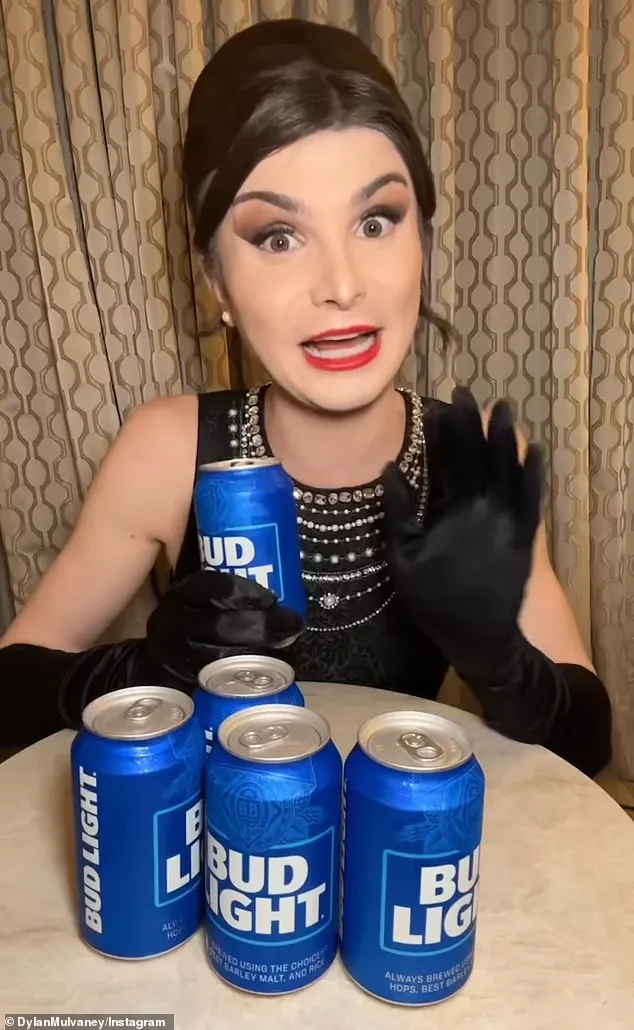
This will be controversial, but Bud might have been more successful if it was able to use the unease its brand users had with things like ‘gender fluidity’ to inform a creative brief that ‘addressed their anxieties and desires”. Surely there is some potential for a humorous - but still inoffensive campaign there?
If advertising has lost the ability to engage honestly with the anxieties and aspirations of its audience, then it must rediscover that capability if we are ever to see a new generation of iconic brands.
Posted 7 July 2026 by Chris Bullick